Showing posts with label Italy. Show all posts

Tuesday, 19 June 2012

Finalized Itinerary

The time has finally come, I'm on my way!  I'm currently sitting in the airport in Detroit, waiting for a flight to London this evening.  My itinerary has changed a little bit since the last update, so here's the current plan:


·         Istanbul-6/20-6/25
·         Ravenna-6/25-6/29
·         Rome-6/29-7/3
·         Bari-7/3-7/5
·         Brindisi-7/5-7/8
·         Otranto-7/8-7/9
·         Taranto-7/9-7/10
·         Catanzaro-7/10-7/13
·         Reggio Calabria-7/13-7/14
·         Palermo-7/14-7/19

I think most places I'll be staying have wifi, so I should be updating this fairly frequently.  Keep your eyes peeled!  I should be putting up the first update from the trip either Thursday or Friday.  Wish me luck!


Thursday, 26 April 2012

More Detailed Itinerary

I've started booking tickets to various places, and my plans have changed somewhat since the last post.  At this point things are pretty well set, though.  So here's the plan:


If you click on the name of each city I've listed, you'll be taken to the wikipedia page about.  Each of these places has either a castle, cathedral, palace, or something of the sort that's built during the 11th century or earlier, which is the primary time frame I'm dealing with.

So as you can see from my last post, I've cut out a few places and am staying longer in a few others instead.  I think this will make the whole experience less hectic for me, plus I think it's more likely to wish I had more time somewhere than to be bored and wish it was time to leave.

Have any of you been to any of these cities?  Any can't-miss sites?  Leave a comment!

Thursday, 5 April 2012

Where I'm going and for How Long

Although I still haven't bought any tickets yet, I've started to narrow down where I'll be going this summer, as well as when.  I'll update again when things are more set in stone, but at the moment I'm planning on leaving around the last week of June, and returning in the first week of August.  The tentative plan is to:
  • Spend about 4 days in Istanbul, Turkey.  This is primarily to acquaint myself with Byzantine art and architecture, so that I'll be able to notice its influence more readily.  Plus, it's Istanbul: how could I not go there?  After that, I'll be going to Italy for the remainder of the trip.
  • About 3 days in Ravenna
  • About 4 days in Rome
  • For the remainder of the trip I'll be in Southern Italy.  I'm planning to go to cities such as Naples, Salerno, Amalfi, Benevento, Bari, Brindisi, Otranto, Taranto, Catanzaro, Reggio Calabria, and Palermo.
 For the most part I'll be in these cities for no more than 2 days, and in most cases only 1.  At least that's what I'm thinking at the moment; I may change my mind and go to far fewer places, but spend more time in each one, maybe taking some side trips to nearby villages.  Like I said, when I have more things nailed down (and when I've spoken with my adviser about my plans in greater detail), I'll update with an actual itinerary.

Friday, 10 February 2012

A little history: why Italy?

To understand what I'm trying to do during this trip, I think I need to explain some (very basic) Byzantine History.  Don't worry, it won't be too long.  I'll try not to bore you.

Although the Roman Empire collapsed in Western Europe during the 5th century, in the East it continued for another 1000 years.  This is what I mean when I talk about the Byzantine Empire: the Eastern Roman Empire, whose capital was Constantinople, and which eventually was defeated by the Ottoman Turks in 1453 AD.

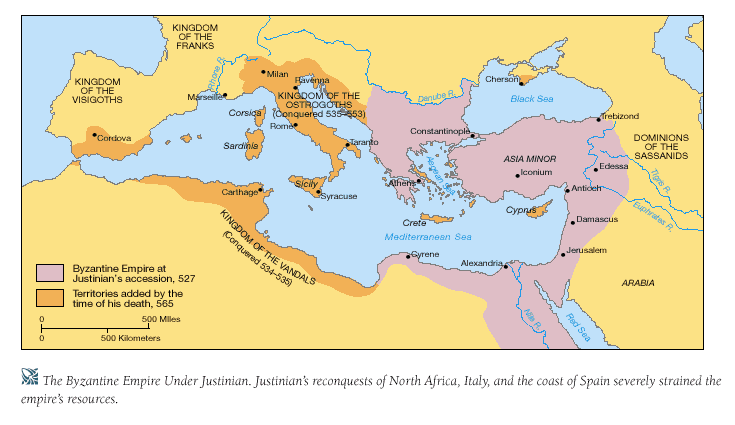
So, if the Byzantines were in the Eastern Mediterranean, what do they have to do with Italy?  In the 6th century the Byzantine emperor Justinian decided to reconquer the Western Roman Empire, taking it back from the "barbarian" Goths and Vandals.

As you can see from that map, he was pretty successful: all those areas in orange had been under the control of Germanic kings, and over the course of his just under 40 year reign, Justinian retook them all.  A lot of these areas were quickly lost again, particularly to the Muslims in the 7th and 8th century, but that's not important for my purposes.  The Byzantines clung to parts of Italy all the way up until the fall of Bari in 1071 AD, over 500 years after Justinian's death.

Being in Italy that long, the Byzantines surely left a mark.  But, Byzantine Italy is virtually unknown to the modern tourist; a lot of the best sites are in the South of Italy, far from the big 3 of Venice, Florence, and Rome.  Travelers to Venice get a glimpse: the Basilica di San Marco is built in the Byzantine style.  The biggest difference is that Venice as a political entity was more independent.  A lot of the cities I'll be visiting in Southern Italy were directly controlled by the Byzantines.  Byzantine Italy isn't given much attention even by historians.  The medievalists don't want to get involved with Byzantine History, since the sources are so different (not to mention that you have to know Greek), and the Byzantinists focus on other areas of the empire.  There are a few sites that are reasonably well known, but the Western edge of the Byzantine Empire just doesn't get the attention that the Balkans and Asia Minor do, for example.

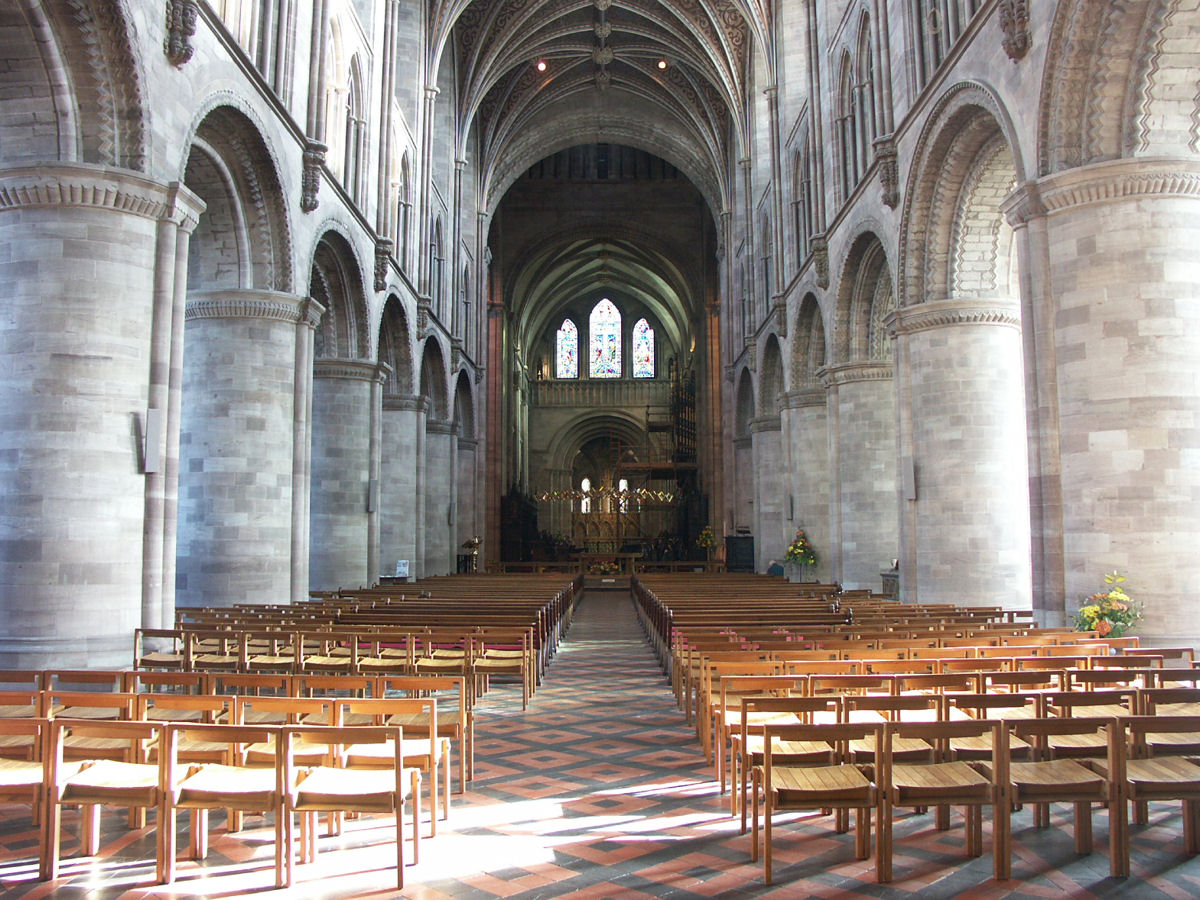
So, for this trip, I'm going to be traipsing through Italy, trying to find bits of Byzantium that still survive, as well as Byzantine influence on their conquerors (even today, there are communities in Southern Italy who speak primarily Greek).  I'm mainly going to be looking at ecclesiastical and secular architecture, as well as art.  Even though both areas were predominantly Christian, artistic style varied quite a between the West and the East.  Take a look at these two cathedrals, as an example:


These churches are roughly contemporary.  Both are from the 12th century and in fact, both were constructed by the Normans.  The top picture is of the Duomo di Monreale in Sicily, and the bottom is of Hereford Cathedral in England.  The difference is that Monreale was built with the help of Byzantine craftsmen, who had a huge influence on the style of the building.  Monreale is a particularly splendid example, but I'm going to be looking for buildings like this on a less fantastic scale, to try to gauge how pervasive Byzantine influence was, especially after the Normans controlled the peninsula.

So, I hope that wasn't too boring.  I think that with a little basic background the pictures I take and descriptions I give will make a little more sense.  I also hope that I explained everything well enough; if you have a question, leave it in the comments and I'll try to answer it.

Thursday, 9 February 2012

What's going on here?

As some of you may know, this summer I've been given the opportunity to travel to Italy to do some research, for credit, while still on my fellowship from The Ohio State University. What this means, in effect, is that I have a chance to spend the summer in Italy, going wherever I want to go and looking at whatever I want to look at, get graduate credit for doing so, get paid my normal fellowship money, and get a stipend for independent research on top. Add in the fact that I have enough frequent flier miles to get a plane ticket to Europe for free and this was a no brainer. I've been trying to get back to Italy since the day I left in December 2008, and this is too good to pass up. Those of you who aren't in Columbus, don't feel too bad: I couldn't have come back to Baltimore or taken a vacation elsewhere anyway. I have to get credit this summer, so it's either Columbus or Europe. For those of you in Columbus, sorry: Italy will beat you, every time.

Lots of you may be asking yourselves "Self, why would Frank write a travel blog?" And surely your self would respond with "I have no idea, stop talking to yourself." Well fear not, imaginary arguers, I'll explain! Although I've been on trips for long periods of time in the past, I never bothered to do this, and looking back, I'm kind of kicking myself over it. Not only would I have made my experiences abroad accessible to more of my family and friends, I'd also probably be able to remember everything a bit better myself (or at least I'd have a record I go back and look at). So, there's one reason. Reason number two is that maybe, if I'm really lucky, my posts will help inspire someone else to go travelling, and instill in them the love of history and Europe that I've found within myself. That came out a little bit cheesier than I'd have liked, but I hope that you catch my meaning.

My plan for this blog is to update as frequently as possible, including lots and lots of pictures of where I've been since the last update, some history (but no more than you need to know to appreciate the pictures. Scout's honor), and any useful little travel tips I happen to pick up along the way. Assuming this goes well--fingers crossed--when I go abroad in the future I'll continue with the updates.

Finally, on the off chance someone who doesn't know me stumbles onto this blog and wonders who this mysterious traveler is, I'll tell you. My name is Frank (that's me up there in the corner), and I'm a PhD student at OSU, studying Byzantine History. As an undergrad at St. Mary's College of Maryland (about which you can read all you'd ever want to know and more here), I studied abroad a few times, spending spring break of freshman year in St. Petersburg, fall of my sophomore year in Alba, Italy (a small town in the Piedmont, near Torino. You may know of it because of truffles), a week and a half during the summer before junior year touring Japan, and fall of my junior year at the Centre for Medieval and Renaissance Studies in Oxford, England. As you might have gathered, I got bit by the travel bug, HARD (at least as hard as anyone without a trust fund can be bitten). I went straight from St. Mary's to OSU, and this trip to Italy will be occurring the summer after my first year there.