Showing posts with label Rome. Show all posts

Tuesday, 3 July 2012

Final Hours in Rome

To wrap up in Rome, I went back to all the churches that were either closed or otherwise occupied when I first visited.  I started off at the Basilica di Santa Prassede, near Santa Maria Maggiore.  The current structure is from the 8th century, and the mosaics inside from the 9th.  It's not a particularly large building, so it was possible to get right up close to much of the artwork.


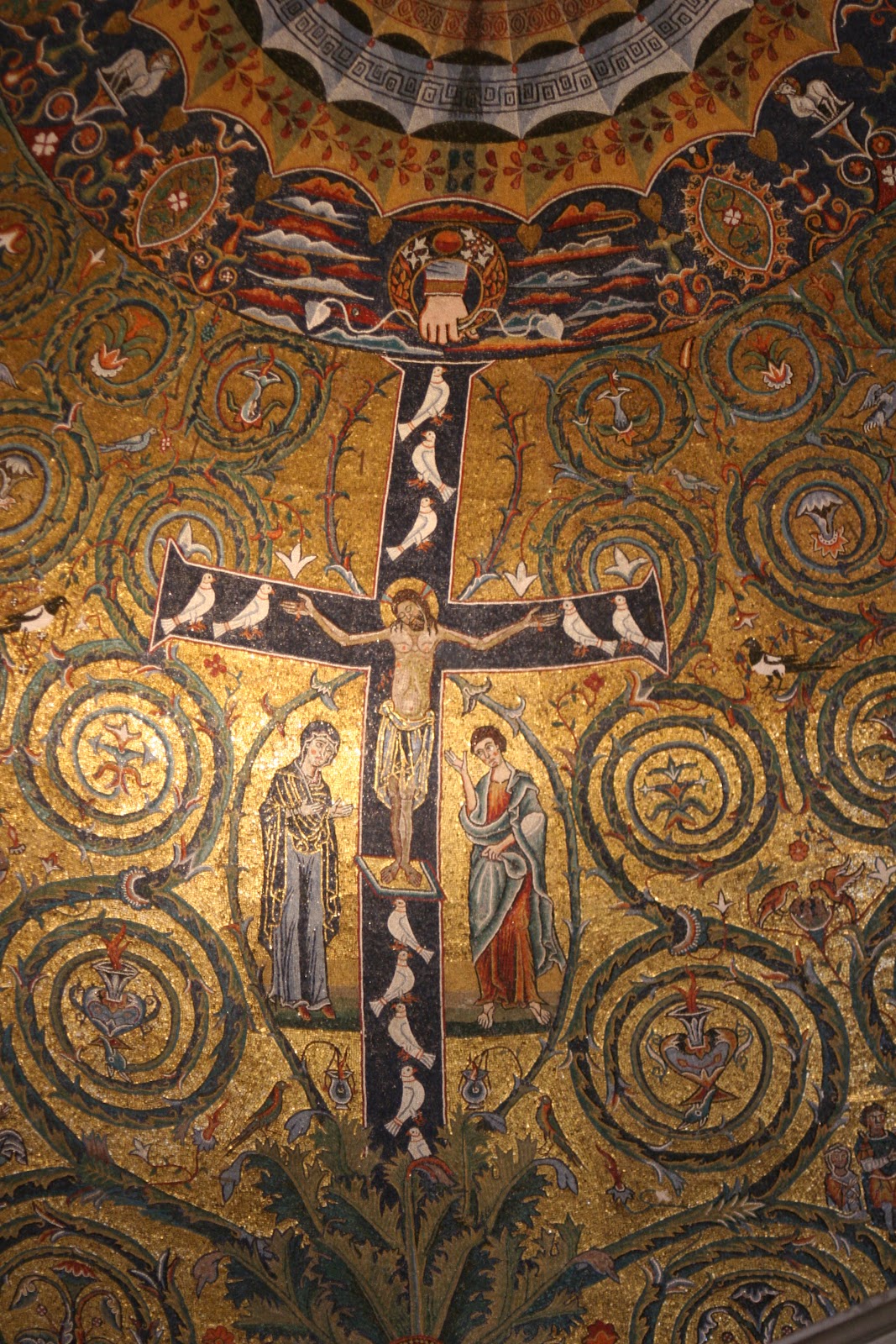
Notice the design in the apse.  Look familiar?
I'm really glad I made it to this one; I'd tried every day, but my timing was always wrong.

Next up was Santi Giovanni e Paolo (there was a wedding last time I was here).  The church dates from the 4th century, and is named after two Roman soldiers who were martyred by Julian the Apostate, the last pagan Roman emperor.  From the outside I expected it to be quite ancient...


...but inside it had been extensively renovated (and apparently still set up for the wedding):


I was a bit disappointed since from the outside it looked so promising, but then I discovered that there were the ruins of a Roman house underneath, complete with 3rd-4th century frescoes.


There were lots, lots more frescoes, but after I took these two pictures I was told that no photography was allowed.  A lot of them were very well preserved; I highly suggest that you visit if you get the chance.

Lastly, I went back to the Basilica di San Lorenzo Fuori le Mura.  One of the papal basilicas of Rome, the current structure dates to the 6th century, and is the resting place of St. Lawrence (he was martyred by being roasted on an iron grill.  Partway through, he cried out "Turn me over, I'm done on this side!"  He's also the patron saint of the cathedral in Alba, Italy, where I spent a semester 4 years ago).


I only managed to get inside between 2 funerals (the church is right next to a very large cemetery), but it was quite impressive inside:


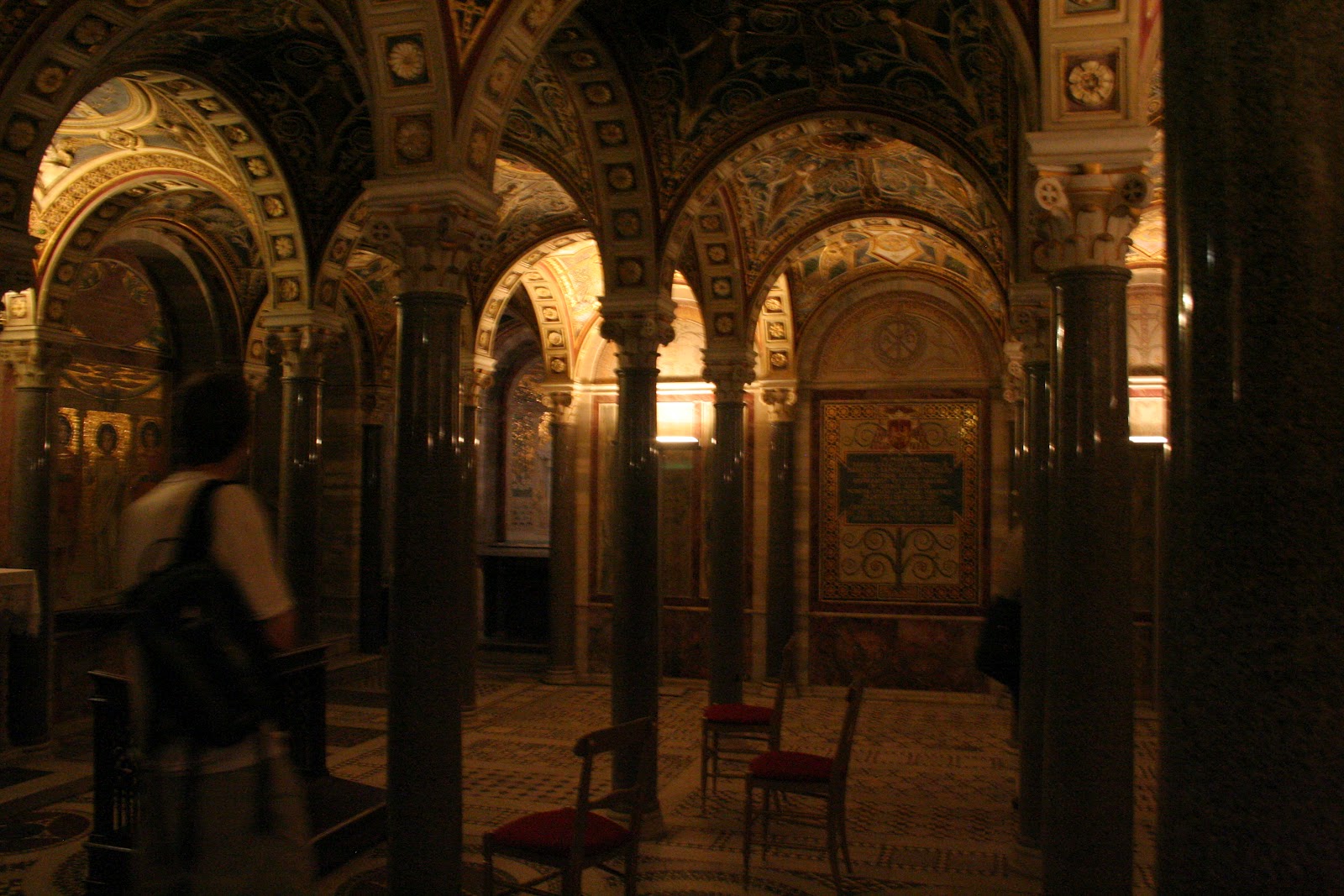
The mosaics date the the 6th century, and were done by the Byzantines after Justinian's reconquest.  There's also a crypt covered in mosaics, but it dates to the 19th century.  It's rather out of the way, but I'm glad I managed to get inside.

I had planned to see Ostia Antica, the ancient port of Rome, but it turns out that the archaeological park is closed on Mondays.  So instead I just wandered around a bit and got my things together.  I'm writing this in Bari, and tomorrow I'll be exploring the city.  On Thursday, it's off to Brindisi.  A domani!

Monday, 2 July 2012

Churches on a Sunday

Sorry for the delay in this post, I went out to watch the Euro Cup Finals last night and didn't get a chance to write.  I managed to do a pretty good job making up for lost time, going on a whirlwind tour of churches in Rome.  I ran into similar issues as I did on Saturday (weddings and Masses), but most of the churches I went to were larger and I was able to go inside anyway.  Most of the interiors of these churches were fairly nondescript, so I'm going to try to keep this one brief and just hit the highlights.

I went to five churches before lunchtime (one about to have a wedding, one about to have a Mass, one actually in the middle of a wedding, one where I actually attended Mass, and one where a wedding had just ended).  The first was Santi Cosma e Damiano.


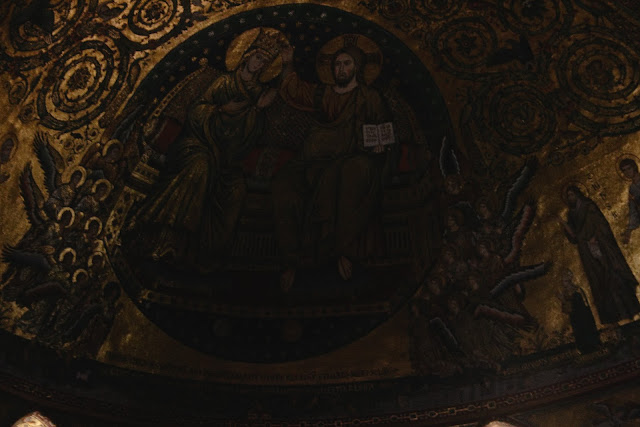
The church is actually a part of the Roman Forum, and is built on top of an old temple to Romulus.  It was converted to a church in the 6th century by Theoderic (the Gothic king whose tomb I saw in Ravenna).  The main reason I was there was for the mosaics in the apse, from the 6th-7th century:


Sorry it's a bit dark; these churches are not especially well-lit, and I'm not using flash.  I was surprised at the level of detail here, as it seems much higher than the other mosaics from that time period that I've seen.  I'll have to do a little more research to see whether this is because of restorations over the centuries or something else.

Next up was the Basilica di San Marco.  Quite different from its more famous cousin in Venice, the interior here is much more baroque in style:


Once again, I wasn't really there for the majority of the church, but rather the mosaics found in the apse:


Notice the design here: Christ, flanked by three people on either side, with the leftmost person (from the viewer's perspective) being the patron who built the church.  Beneath, a procession of lambs going from Bethlehem and Jerusalem, with a lamb with a halo (Christ) in the middle.  I ran into this same design in many of the churches I saw, and they all date to around the 9th century.  I need to do a little a digging here, to see if this is a particularly Roman design, a design common in the 9th century, both, or neither.  I saw something similar while in Ravenna (the procession of lambs), but this was in a much earlier church, Sant'Apollinare in Classe.

I next went to Santa Maria in Aracoeli, a church dating back to at least the 6th century but greatly renovated over the years.  While it was beautiful, there was little of particular interest to me here.  There were some medieval tombstones on the floor though, marking the burial places of important patrons of the church.  It also houses the relics of St. Helena, the mother of Constantine.  This is the church that was in the middle of a wedding, so I neglected to take any pictures (the last thing I need is an angry Italian bride yelling at me).

After this I attended Mass at San Nicolo in Carcere.  Like Santa Maria, although the church was ancient it has been renovated so extensively that there wasn't many ancient things left.  It is possible to view the ruins beneath the church, but apparently not immediately before or after Mass.  Also, since I was there for a church service, I didn't take any pictures.

Next I went to Santa Sabina, at the top of the Aventine Hill (readers who watched the HBO series "Rome" may remember that this is where Titus Pullo and Lucius Vorenus live).  The church dates back to the 5th century, its architectural integrity largely intact:


Original (I think) stonework
Mosaic inscription
Originally this church would have had a large apse mosaic, but this has been replaced by a fresco.  Although the climb up is grueling, it's well worth it at the top; in addition to the church there is a really nice garden overlooking the city, and dozens of orange trees.  The smell is divine, and if you're hungry there's quite literally fruit ripe for the picking.

After Santa Sabina and some lunch, I made my way to Trastevere, literally "Across the Tiber."  This is a somewhat less frequented area of Rome, and it's home to two important churches.  The first (and probably most well known) is the Basilica di Santa Maria in Trastevere.


The church is one of the oldest in Rome, dating back to the 3rd century (although not the current structure).  There are some 13th century mosaics in the apse (which I was unable to access because Mass was about to start), but what was most interesting to me was beneath the present church; you can access the ruins of the original basilica:


Medieval frescoes
Ancient tombstone
I was the only person down there, and it was awesome to imagine what the original church must have been like.

I also went to the Basilica di Santa Cecilia in Trastevere, not too far from Santa Maria.


Much like Santa Maria in Trastevere, the first church on the site dates back to the 3rd century, while the present structure is from the 9th (and renovated since).  The mosaics of the apse have been preserved (and my apologies for misleading Brad and Melissa, an American couple I met at the church.  The mosaics look quite early to my eye, but are in fact 9th century).  Look familiar?


Also like Santa Maria, you could go beneath the church.  In this case, the area is believed to have been the house of St. Cecilia.
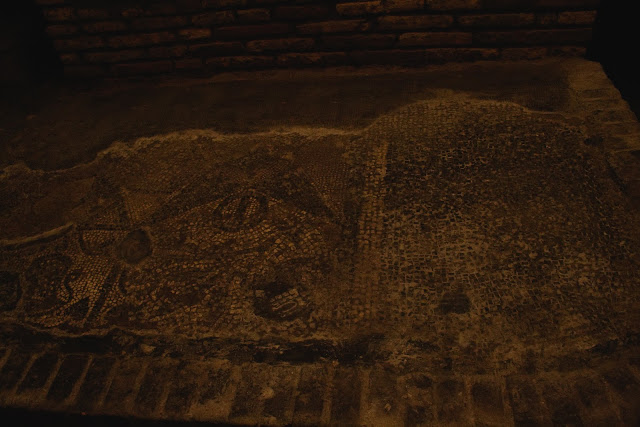
Roman mosaic floor
Ancient tombstone
Crypt, dedicated in 1900
Looking at all these ruins was definitely the highlight of the day.  If you go to Rome, I highly suggest checking out Trastevere.  It's a little more off the beaten path, and that makes it even better,

Saturday, 30 June 2012

Early Christian sites...sort of.

Today was a good day, although my efforts at seeing a couple important early Christian churches were thwarted by masses and weddings.  But, even though things didn't go according to plan, I still got to explore Rome (and familiarize myself with the public transit system).

I started off by going on the Via Appia Antica, aka the Appian Way.  The road was first used in the 4th century BC, and it connects Rome to southeast Italy.  Parts of it are the original Roman road, and shockingly, you are allowed to drive on it (a testament to Roman building techniques, I suppose).  There are some pretty interesting ruins and beautiful views along the way, too:


I walked along for a bit, until I came to the Basilica di San Lorenzo, originally built by Constantine in the 4th century, although heavily modified over the years.  The church itself is nice...


...but I was really there for what's underneath.  Some of the oldest Christian catacombs in Rome are beneath this basilica.  There are three levels, with the highest being the oldest, but you can really only explore level 2; the others are too dangerous, although there are a couple areas that you're allowed to go into.  You are also required to go with a guide; normally this would bug me (I'd much prefer to just do it on my own.  Go figure, from the guy who's on a month-long trip by himself), but I could easily see how you could get lost down there, or potentially hurt yourself, particularly if you happen to be prone to claustrophobia.  There are a variety of fairly average grave sites (at one time over 100,000 people were buried here), as well as a few special ones, such as the tombs of St. Lawrence, St. Peter, and St Paul (all of whom have been moved), and 3 pagan mausoleums which are believed to have been the original burials in the area.  I wasn't allowed to take pictures, but above ground they had a few of the Christian sarcophagi on display, all from the 4th century:


Even if these catacombs are a bit out of the way, they should be at the top of the list for visitors to Rome.  Not impressive in the same way that the Coliseum is, but fantastic nonetheless.

Afterwards, I started walking up the Appian Way back towards Rome, and went to the Chiesa di Domine Quo Vadis.  According to tradition, Peter was fleeing Rome ahead of his imminent execution when he saw a vision of Jesus, walking towards Rome.  He asked Him "Domine, quo vadis?" meaning "Lord, where are you going?"  Jesus responded that he was going to Rome to be crucified again.  Peter got the message and turned around to face his death, by upside-down crucifixion (at his own request; he felt unworthy of dying in the same manner as Jesus, so he had the Romans turn his cross upside-down).  The church marks the spot where this event was believed to have taken place, complete with a piece of marble with the supposed footprints of Jesus embedded:


After this, I tried to go to the Basilica di San Lorenzo Fuori le Mura.  I say tried, because the attempt was a pretty spectacular failure.  First I couldn't figure out the buses to get there, then when I finally did there was Mass going on, and then I couldn't figure out the buses going back.  All in all I probably wasted about 2 hours.  I plan on trying again (now that I have a better idea of where I'm going), but in the meantime here's a picture of the outside:


Next up was the Basilica di San Paolo Fuori le Mura, in a totally different part of town ("fuori le mura" just means "outside the walls").  The original church dates back to the 4th century, but there was a massive fire in the early 19th century and much was destroyed (although not the apse mosaics; I'll get to those in a minute).  No expense was spared in the reconstruction, and you can tell:


This place is BIG.  Like fit-most-other-churches-inside-of-it big

Triumphal arch mosaics

The apse
The mosaics are one of the few things to survive the fire, although to call them original is a stretch (various "restorations" have been performed over the years).  There is a much higher level of detail in these mosaics than the Byzantine ones I've seen thus far (mostly noticeable in facial features), and I think that this is a result of restorations made over the years as well as the sheer scale.  I thought that San Giovanni in Laterano must have been the second largest church in Rome after St. Peter's, but now I think the distinction probably has to go to St. Paul's

To finish out my day, I tried to go to Santi Giovanni e Paolo, fairly close to the Circus Maximus and Coliseum.  Once again I say tried, because when I got there I ran into a wedding.  Like San Lorenzo this is a pretty important stop for me, so I'll be trying again (presumably there won't be weddings on Mondays, but I'm afraid I'm setting myself up for an incredibly hectic day).  Here's a shot of the outside for now:


Feeling rather defeated, I called it a day after this.  Tomorrow I'll be attending Mass in the morning (I think at  SS. Cosma e Damiano, near the forum), and then trying to get into as many churches as possible that are left on my list.  I'm hoping that the Masses will be mainly in the morning (they usually are), so that after lunch I should be able to see quite a few.  At least I hope so, because if not Monday will be busy, busy, busy.  Wish me luck!

Friday, 29 June 2012

La Citta Eterna

There's something about standing in a city that's existed for over 2500 years.  You can't exactly put your finger on it, but it's hard not to be in a good mood (even in sweltering heat).  I've been to Rome before, just under 4 years ago when my parents came to visit me in Alba, but I won't be seeing much of any of the same sites.  They say that you can't see all of Rome in a lifetime, so why do the same things twice?  Conspicuously absent from the next four days will be the Coliseum, Vatican Museums, Capitoline Hill, etc.  If you're interested in those things, check out my Facebook page; I've got plenty of pictures from the last time I was here.

Instead, my focus is going to be on churches (surprise, surprise), preferably as old as possible.  I didn't get to Rome until 1 PM local time today, but I tried to hit the ground running since there's so much to do.  First up the Basilica di Santa Maria Maggiore, atop the Esquiline Hill.
From the front...
...and the back.
The church was originally built in the 5th century, although obviously heavily modified over the years.  It's one of the four Papal Basilicas in Rome, meaning that it technically is owned by the Vatican rather than Italy (think like an embassy on foreign soil).  Being one of the most important churches in Rome, it was rather splendid inside:


Detail of the apse
Triumphal arch mosaics
These mosaics date from to the fifth century, making them older than just about everything I saw in Ravenna. I really wish I had a pair of binoculars with me; there are also mosaics lining the nave, but they were too high up to either get a decent picture of or even see well in person.  Quite the impressive church, all in all.

Next up was the Basilica di San Clemente.  While the church itself if quite beautiful...


These mosaics are significantly more recent, dating to the twelfth or thirteenth century.  If you compare them with some of the other shots I've taken, they do look quite a bit different.
 ..the real draw of this church is the fact that beneath it lies a 4th century Christian basilica, and beneath that is a 1st century AD Mithraeum (a temple to Mithras) and a Roman house, complete with running water (still functioning).  Unfortunately we weren't supposed to take pictures, but I managed to snap one before a mysterious voice told me to stop in 4 or 5 different languages:

The Mithraeum
Sorry for the quality, it was extremely dark down there.  Anyway, this church should be on any visitor to Rome's list.  It really gives you an impression of just how old the city is.

Not too far away from San Clemente is San Giovanni in Laterano, the official cathedral of Rome.  While the pope is usually associated with St. Peter's in the Vatican, his actual "home church" is San Giovanni.  Next  to the St. Peter's it is probably the most magnificent in Rome:


These massive statues line the nave

The bishop's throne or cathedra (hence the term cathedral)
There were some nice mosaics here as well, but once again they date from the 12th or 13th century.  In the interest of time I'm going to leave them out, but as I've mentioned before I'll be putting up a photobucket where you can see everything I saw (the internet in these hostels isn't the best; this might not happen until I get home, since we're talking about thousands of pictures).

I also saw the Scala Sancta, believed to be the steps from Pontius Pilate's palace in Jerusalem, which Jesus ascended before he was condemned to death.


You are only allowed to climb it on your knees, saying a prayer on each step (there are other staircases to the sides for those who don't want to do this), and as a result the penitent are granted a partial indulgence (or a plenary indulgence, if you climb on Good Friday).  I decided to go for it--though I still need to go to confession and attend mass some time in the next couple weeks for the indulgence to count--and it is definitely a grueling experience.  Quite moving, though; there were various people crying as they climbed, and it didn't seem to be because of the pain.  At the top is the Sancta Sanctorum, a chapel housing some extremely ancient relics.  Photos are forbidden, and you can't even go inside--you can only look from 3 grated windows.

Although completely exhausted after this experience, it was too early to call it a day, so I went to the Basilica dei Santi Quattro Coronati.  An ancient church (4th-5th century), it is now operated by the Little Sisters of the Lamb.

Very unassuming exterior.  You'd never find this place if you weren't looking for it.
Decoration in the apse is much more recent (I'm guessing 16th-17th century)

The cloisters
A chapel with some crumbling frescoes
Finally, I finished the day by going to Santo Stefano Rotondo, a round church fairly close to Quattro Coronati.  But, I happened to catch it on a day when there was a wedding going on.  The wedding itself was over, and I managed to get inside, but pretty quickly I was told I had to leave because they were closing for the day.  I'm going to try to go back, so I'm not going to include any information on that church now.

Tomorrow, I'm planning on doing the Appian Way and the early Christian catacombs, as well as some of the more out of the way sites (such as St. Paul's Outside the Walls).  As usual, leave me your questions and comments!