Wednesday, 4 July 2012

Santa Claus IS real; I saw his church

I got into Bari yesterday afternoon, and set out exploring this morning.  The town itself is beautiful; it reminds me of a little chunk of Venice.  The shore is never very far away (although there are no canals), and most of the buildings are made of stone rather than the brick of Rome.  I'm only here for a day, but there aren't too many sites for me to see.  I could definitely see coming here to just relax for a vacation, though.  The proximity to the sea keeps the temperatures much more manageable; wandering around was actually quite pleasant.  Beautiful, too:
View of the Adriatic Sea
Seminary


Column commemorating Bari as the final Byzantine city in Italy

One of the main piazze
Old column and lion (with no label, so I'm not sure of the significance.  They look medieval, though)
The old city is right up against the water, but Bari has grown far, far out of the medieval quarter.  The old streets are actually designed to be confusing, in order to thwart potential attackers, making for a rather confusing experience.  The first place I went was the Basilica di San Nicola.  In the 11th century, sailors from Bari raided the resting place of Saint Nicholas (aka Santa Claus) in Turkey.  When the got back to Bari, this church was built to house the remains.


Notice how the arches aren't perpendicular to the nave
The church as built after the expulsion of the Byzantines, and is an example of the Romanesque style of architecture.  I was unable to get up into the apse, because--take a wild guess--there was about to be a wedding.  I did get a picture of it, as well as a 14th century fresco and a 15th century triptych:

Sorry for the blurriness
The crypt is particularly excellent, though.  This is the oldest section of the church, and is believed to have originally been a part of a Byzantine palace.  It currently houses a number of relics of St. Nicolas, including the remains brought back by the sailors.

The columns are Byzantine and Romanesque
The icon of St. Nicolas.  Prayers are written on money, napkins, bus tickets, etc.
Column believed to be part of the original palace, and the original mosaic floor of the crypt
Altar and remains of the saint
While I wish I could have seen the apse better, this was still pretty cool.  I also sat in on the end of a Mass in the crypt, which was nice as well.

Next I tried to go to the Swabian Castle, built in the 13th century over earlier Norman and Byzantine foundations.  It currently houses art expeditions.


Unfortunately, the castle was closed on Wednesdays, so I wasn't able to go inside.  Not a huge loss, but it would have been a nice thing to do for the afternoon.

I next went to the Cathedral of Bari, dedicated to Saint Sabinus.  The church is older than the Basilica di San Nicola, though usually overshadowed by it.  The current structure is from the 12th-13th century, but there was a church on the site as far back as the early Christian period.


Check out the elephants at the base of the columns

Much like some of the churches I saw in Rome, I was able to go down into the archaeological area and see the ruins of the former church in this spot.

Medieval frescoes

Fantastic mosaic floor from the old church, from the 6th century.
Roman road adjacent to the old church
Ruins of a second church, from the 9th-11th century, that was built next to the original Roman structure.
The archaeological area was fantastic; I wish that the old structure was still standing, but I guess this is the next best thing.

I tried to go to the Diocesan Museum, but it was under renovation.  There were also a number of small churches in the city that were rather old, but none of them were open (or even had hours posted).  This was the only day I'm spending in Bari; tomorrow I'm off to Brindisi.  Apparently Bari is a popular spot to catch a ferry to Greece.  If you should happen to be planning this, I'd suggest booking a day in Bari itself and enjoying the city.  Next post tomorrow evening, from Brindisi!

Tuesday, 3 July 2012

Final Hours in Rome

To wrap up in Rome, I went back to all the churches that were either closed or otherwise occupied when I first visited.  I started off at the Basilica di Santa Prassede, near Santa Maria Maggiore.  The current structure is from the 8th century, and the mosaics inside from the 9th.  It's not a particularly large building, so it was possible to get right up close to much of the artwork.


Notice the design in the apse.  Look familiar?
I'm really glad I made it to this one; I'd tried every day, but my timing was always wrong.

Next up was Santi Giovanni e Paolo (there was a wedding last time I was here).  The church dates from the 4th century, and is named after two Roman soldiers who were martyred by Julian the Apostate, the last pagan Roman emperor.  From the outside I expected it to be quite ancient...


...but inside it had been extensively renovated (and apparently still set up for the wedding):


I was a bit disappointed since from the outside it looked so promising, but then I discovered that there were the ruins of a Roman house underneath, complete with 3rd-4th century frescoes.


There were lots, lots more frescoes, but after I took these two pictures I was told that no photography was allowed.  A lot of them were very well preserved; I highly suggest that you visit if you get the chance.

Lastly, I went back to the Basilica di San Lorenzo Fuori le Mura.  One of the papal basilicas of Rome, the current structure dates to the 6th century, and is the resting place of St. Lawrence (he was martyred by being roasted on an iron grill.  Partway through, he cried out "Turn me over, I'm done on this side!"  He's also the patron saint of the cathedral in Alba, Italy, where I spent a semester 4 years ago).


I only managed to get inside between 2 funerals (the church is right next to a very large cemetery), but it was quite impressive inside:


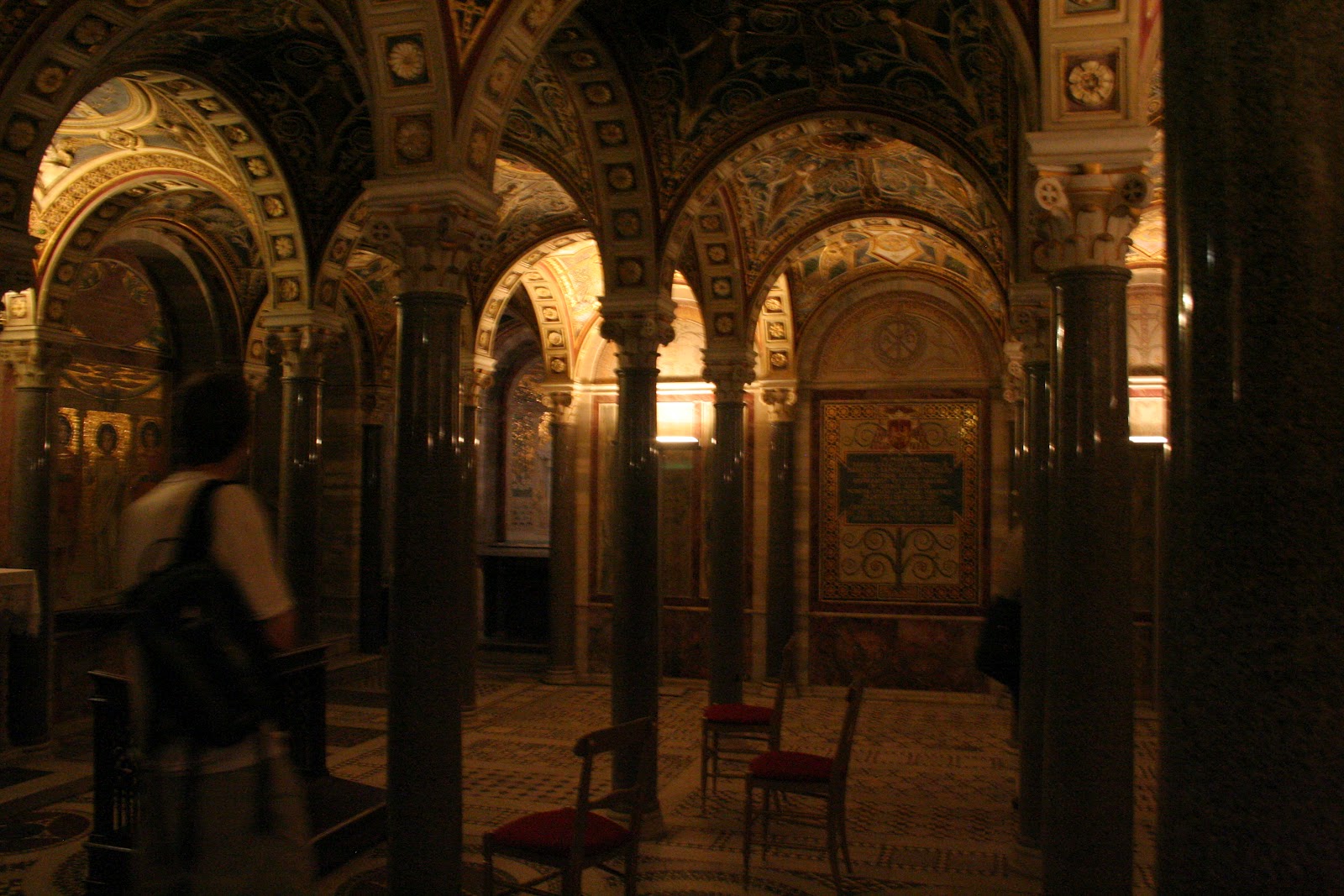
The mosaics date the the 6th century, and were done by the Byzantines after Justinian's reconquest.  There's also a crypt covered in mosaics, but it dates to the 19th century.  It's rather out of the way, but I'm glad I managed to get inside.

I had planned to see Ostia Antica, the ancient port of Rome, but it turns out that the archaeological park is closed on Mondays.  So instead I just wandered around a bit and got my things together.  I'm writing this in Bari, and tomorrow I'll be exploring the city.  On Thursday, it's off to Brindisi.  A domani!

Monday, 2 July 2012

Churches on a Sunday

Sorry for the delay in this post, I went out to watch the Euro Cup Finals last night and didn't get a chance to write.  I managed to do a pretty good job making up for lost time, going on a whirlwind tour of churches in Rome.  I ran into similar issues as I did on Saturday (weddings and Masses), but most of the churches I went to were larger and I was able to go inside anyway.  Most of the interiors of these churches were fairly nondescript, so I'm going to try to keep this one brief and just hit the highlights.

I went to five churches before lunchtime (one about to have a wedding, one about to have a Mass, one actually in the middle of a wedding, one where I actually attended Mass, and one where a wedding had just ended).  The first was Santi Cosma e Damiano.


The church is actually a part of the Roman Forum, and is built on top of an old temple to Romulus.  It was converted to a church in the 6th century by Theoderic (the Gothic king whose tomb I saw in Ravenna).  The main reason I was there was for the mosaics in the apse, from the 6th-7th century:


Sorry it's a bit dark; these churches are not especially well-lit, and I'm not using flash.  I was surprised at the level of detail here, as it seems much higher than the other mosaics from that time period that I've seen.  I'll have to do a little more research to see whether this is because of restorations over the centuries or something else.

Next up was the Basilica di San Marco.  Quite different from its more famous cousin in Venice, the interior here is much more baroque in style:


Once again, I wasn't really there for the majority of the church, but rather the mosaics found in the apse:


Notice the design here: Christ, flanked by three people on either side, with the leftmost person (from the viewer's perspective) being the patron who built the church.  Beneath, a procession of lambs going from Bethlehem and Jerusalem, with a lamb with a halo (Christ) in the middle.  I ran into this same design in many of the churches I saw, and they all date to around the 9th century.  I need to do a little a digging here, to see if this is a particularly Roman design, a design common in the 9th century, both, or neither.  I saw something similar while in Ravenna (the procession of lambs), but this was in a much earlier church, Sant'Apollinare in Classe.

I next went to Santa Maria in Aracoeli, a church dating back to at least the 6th century but greatly renovated over the years.  While it was beautiful, there was little of particular interest to me here.  There were some medieval tombstones on the floor though, marking the burial places of important patrons of the church.  It also houses the relics of St. Helena, the mother of Constantine.  This is the church that was in the middle of a wedding, so I neglected to take any pictures (the last thing I need is an angry Italian bride yelling at me).

After this I attended Mass at San Nicolo in Carcere.  Like Santa Maria, although the church was ancient it has been renovated so extensively that there wasn't many ancient things left.  It is possible to view the ruins beneath the church, but apparently not immediately before or after Mass.  Also, since I was there for a church service, I didn't take any pictures.

Next I went to Santa Sabina, at the top of the Aventine Hill (readers who watched the HBO series "Rome" may remember that this is where Titus Pullo and Lucius Vorenus live).  The church dates back to the 5th century, its architectural integrity largely intact:


Original (I think) stonework
Mosaic inscription
Originally this church would have had a large apse mosaic, but this has been replaced by a fresco.  Although the climb up is grueling, it's well worth it at the top; in addition to the church there is a really nice garden overlooking the city, and dozens of orange trees.  The smell is divine, and if you're hungry there's quite literally fruit ripe for the picking.

After Santa Sabina and some lunch, I made my way to Trastevere, literally "Across the Tiber."  This is a somewhat less frequented area of Rome, and it's home to two important churches.  The first (and probably most well known) is the Basilica di Santa Maria in Trastevere.


The church is one of the oldest in Rome, dating back to the 3rd century (although not the current structure).  There are some 13th century mosaics in the apse (which I was unable to access because Mass was about to start), but what was most interesting to me was beneath the present church; you can access the ruins of the original basilica:


Medieval frescoes
Ancient tombstone
I was the only person down there, and it was awesome to imagine what the original church must have been like.

I also went to the Basilica di Santa Cecilia in Trastevere, not too far from Santa Maria.


Much like Santa Maria in Trastevere, the first church on the site dates back to the 3rd century, while the present structure is from the 9th (and renovated since).  The mosaics of the apse have been preserved (and my apologies for misleading Brad and Melissa, an American couple I met at the church.  The mosaics look quite early to my eye, but are in fact 9th century).  Look familiar?


Also like Santa Maria, you could go beneath the church.  In this case, the area is believed to have been the house of St. Cecilia.
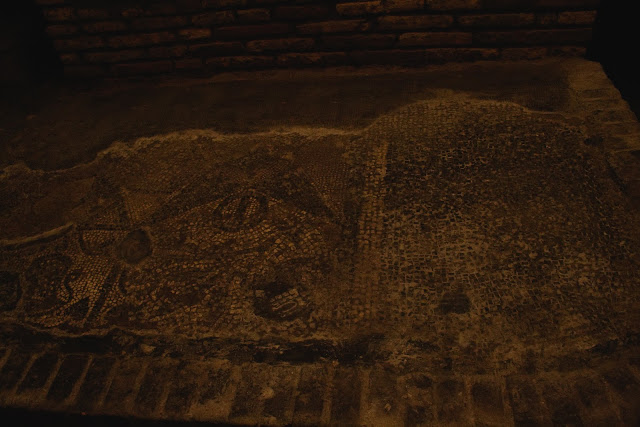
Roman mosaic floor
Ancient tombstone
Crypt, dedicated in 1900
Looking at all these ruins was definitely the highlight of the day.  If you go to Rome, I highly suggest checking out Trastevere.  It's a little more off the beaten path, and that makes it even better,