Showing posts with label Constantinople. Show all posts

Tuesday, 26 June 2012

Wrapping up in Istanbul

Sorry for the delay in this post; the internet in Istanbul was painfully slow (SMCM-level or worse), and the internet was down in my hostel in Ravenna last night.  Not a huge deal anyway; I actually don't have much to say for this one.

Kyle and I had a fairly large day planned to finish up our stay in Istanbul, but it mostly became a lot of walking around.  We started the day by going to the Blue Mosque (free!), a mosque built in the early 17th century and in close proximity to Hagia Sophia.  There's quite a resemblance between the two building, at least from the outside (excepting that the Blue Mosque has 6 minarets to Hagia Sophia's 4):


Not being particularly well-versed in Islamic art and architecture, I'll let the pictures of the interior speak for themselves:


The Mihrab, the section of a mosque that points directly towards Mecca.  These are often not centered, but this one is in the center of the mosque

Nearly all the detailing is done using painted tiles

Because this is still a functioning mosque, we couldn't explore very much; only a fairly small section of the ground floor was open to us (the upstairs is exclusively for women).  The scale is certainly impressive, but I have to admit that I wasn't exactly blown away.  I personally find the decoration pretty boring.  Because of the Muslim prohibition of images in places of worship, the mosque is covered in naturalistic patterns, and it all becomes  bit busy for my tastes after a while.  Definitely an architectural marvel, but not as interesting to visit as other things I'd seen here in Istanbul.

After this, we planned to check out a few other mosques that had originally been important Byzantine churches.  Unfortunately, we struck out completely; every one we went to was closed or under construction, and so we couldn't see inside.  Instead we ended up going to Taksim Square, in the new city, and then we got lost trying to get back (one wrong turn, which we didn't realize we had made until we'd walked for a couple miles).  We did get to try some pretty good seafood for lunch though.  Just a grilled fish sandwich, but it was bought directly from a boat and only cost 5 lira.  Pretty good, I thought.

In the evening, we bought tickets to a concert taking place in Hagia Eirene, the Church of Holy Peace.  This was the second largest church in Constantinople, and like the Hagia Sophia it was built in the 6th century.


Unlike Hagia Sophia, this was never converted to a mosque.  I was used as the sultan's armory though, and so it hasn't been a church for centuries.  It's typically closed to visitors, but open for special events.  The concert was the debut of a contemporary opera, written by an American and in English, about the life of the Muslim poet Rumi.  The opera was...interesting.  But I wasn't really there for the music anyway; I wanted to see the church.  These pictures aren't the greatest (the lights were down, and I didn't have a tripod), but it was a pretty cool experience.  Very few visitors to Istanbul get to see inside:


In the last shot, you can see the cross in the apse; originally, there would have been a much more elaborate mosaic there, such as the Virgin and Child or Christ Pantokrator.  But, when iconoclasm came on the scene, that was destroyed, and this simple cross mosaic put in its place.  The only religious imagery acceptable to the iconoclasts was the cross, and this is a rare example of a church that remains with their decoration (when iconoclasm ended, most churches were enthusiastically redecorated with icons and mosaics).

So, that ends my time in Istanbul.  It was quite a trip, and I'm so glad I went (I've been meaning to get there since I was in Oxford, 3 years ago).  But now I'm even more excited for Italy.  I'm writing this just after my first day in Ravenna; that post should be up shortly after this one.  As usual, ask me some questions!

Sunday, 24 June 2012

State and Church

My time today was divided between secular and ecclesiastical architecture, and I thought this would be a good opportunity to talk a little bit about how little meaning the "church and state" distinction had in Byzantium.  While in western Europe there was at least some independence of the state from the Church, in the East this wasn't really the case.  But, rather than the Church dominating imperial affairs, the situation was the reverse: the emperor was the boss, and by and large the Church--by which I mean the Patriarch of Constantinople--bowed to his will.

This is of course something of an exaggeration; the term "caesaropapism" is no longer widely used, and there are certainly examples of Patriarchs acting in defiance of the emperor's wishes.  But, for the most part, the state was responsible for the Church.  Furthermore, imperial revenue was behind most ecclesiastical building; there were wealthy patrons who funded churches as well, but most of the truly grand buildings--particularly in Constantinople itself--were paid for by the imperial coffers.

This is all sort of a side note, but I thought it had some relevance to what I saw today.  Also, the following is somewhat out of order, in the interest of making the actual post more interesting.  We went to whatever made the most sense based on where we were in the city, but I'm going to cover secular stuff first, then ecclesiastical things.  I started by going to Yedikule, a fortress in the southwest corner of Istanbul.  Literally "Seven Towers" in Turkish, the fortress is a combination of the Royal Gate in the Theodosian Walls and later additions by the Ottomans, creating a fortress with a grand total of 7 towers.  It was never actually used as a fortress, but rather acted as the Ottoman treasury and political prison.  The gate--also known as the Porta Aurea--and the walls give a fairly good impression of just how formidable they were in their heyday:

A shot with some people, for scale
As you can see, these were MASSIVE.  The walls of Constantinople were the most effective defensive structure in Europe without question, and personally I would argue you can count the rest of the world too.  Built in the 5th century AD, they successfully withstood siege after siege, finally succumbing to the Ottomans in 1453 when cannons were used against them.  Part of the reason for their success was the 3 layers of defense:


It's hard to tell from this picture, but the Theodosian walls are in effect 3 separate walls.  Right around the center-left of this picture you can see the crenelations; these stood above a deep moat, so that attackers would have had to fight uphill and against a well defended area to breach the first layer.  Next came the outer wall, which is what makes up the bulk of the picture.  If they managed to get beyond this wall, they then had to scale the much higher inner wall, which is where this picture was taken from.  To make things even more difficult, there were numerous towers on both the inner and outer walls, positioned so that it was impossible to attack without being in the view of one tower or another.  It's not surprising that it took gunpowder to get through these defenses, especially when you see how substantial they really were.  Here are a few more shots of the walls:

From inside Yedikule
Imagine these towers, along with 92 identical twins, and you have a pretty good idea of what the inner wall was like
A view from the very top of one of the towers, looking towards the end of the Golden Horn on the northern end of the city.
In 1453, when the Ottomans finally succeeded in capturing the Queen of Cities, Constantinople held only about 50,000 souls, compared to roughly 1 million in earlier times.  Constantine XI Palaiologos--the final Byzantine emperor--had only about 7,000 men to command, while his attackers were able to field roughly 80,000.  Outnumbered more than 10 to 1, the Byzantines still had the potential to win the battle; had sultan Mehmet II not had his massive cannons, the walls of Theodosius would likely have held the day once again. To see these walls, which stood unbreached for over 1000 years, was truly remarkable.

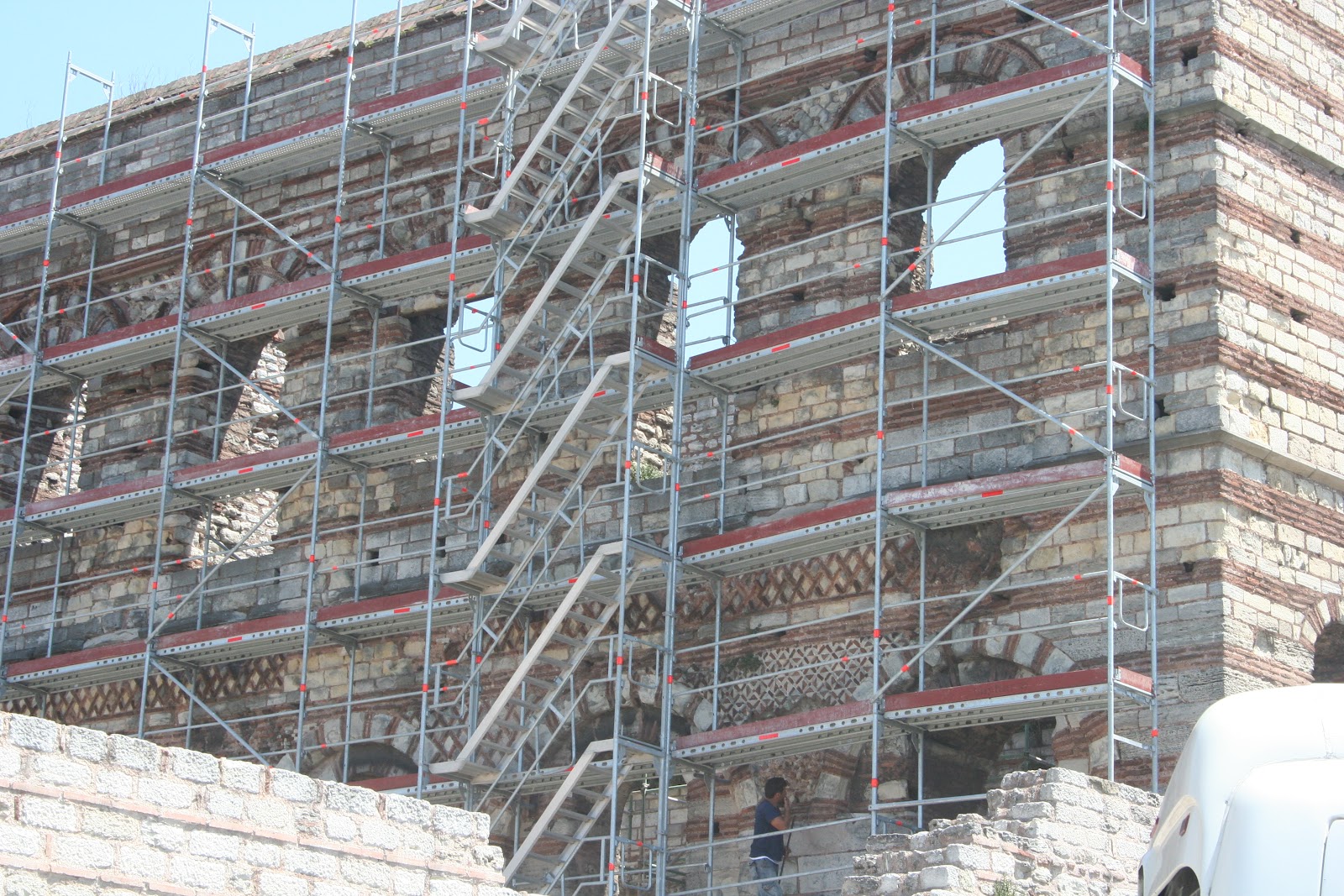
We also saw the Palace of the Porphyrogenitos, a medieval addition to the walls.  It became the preferred palace of the emperors in later years, and was the imperial residence at the time of the siege.  Porphyrogenitos literally means "born in the purple," and was a title given to members of the royal family who were born in a special birthing chamber constructed entirely of porphyry.  These people held the highest status in the empire; members of the imperial family born elsewhere were considered to be of a lower rank, and farther from the succession.  The palace is fairly ruined, although there were construction crews working during our visit.  Hopefully it will be restored and open to the public fairly soon.

Facing into the city...

...and facing out.

Moving to the Church side of "State and Church," we visited the Patriarchate, the seat of the Patriarch of Constantinople.  And yes, I meant to write Constantinople, not Istanbul (despite what the song may tell you).  In Greece, the city is still called Konstantinopolis, and the leader of the Orthodox Church is the still the Patriarch of Constantinople.  The status of the Patriarch is a sore spot between Greeks and Turks (by Turkish law he is required to be a citizen of Turkey; no native Greek can hold the position), but I digress.  Unfortunately (at least in my opinion) the Patriarch is not permitted to be based in one of the ancient churches of the city, but instead is located in a structure from the 19th century.

Quite the difference from his old station in Hagia Sophia, huh?
The interior of the church was fairly nondescript, although it was littered with ancient relics and icons.  However, a church service was just starting, so we refrained from taking pictures inside.  If someone who is reading this happens to be travelling to Istanbul in the future, I would suggest that you visit, at least if you find icons and relics interesting.

We did, however, go to several more noteworthy churches.  One of the most interesting ones was St. Mary of the Mongols.  One of the few (possibly the only, quite frankly I'm not sure) churches constructed prior to the conquest of Constantinople that has remained a church ever since, it was really interesting to see what a church that had been in continuous use for the past 700 years looked like.  The only reason it remains a church is a decree from Mehmet II guaranteeing in perpetuity the sanctity of the space, and that it would never be converted to a mosque (the decree is proudly displayed within).  Like the Patriarchate, the interior itself was relatively plain, but also like the Patriarchate, it had some truly ancient relics and icons.  The front door was locked and we were about to leave, when a man beckoned us to come in and proceeded to give us a tour, pointing out the notable pieces and encouraging us to take photos and explore.

The Iconostasis
Emperor Constantine (a saint in the Orthodox Church) and his mother, St. Helena
There was also a tunnel which leads underground to the Hagia Sophia, several kilometers away.

We also saw two churches notable for their extensive mosaics (in fact, along with Hagia Sophia, they are the 3 places in Istanbul with the most original Byzantine mosaics).  Both were originally churches, then mosques, and now museums (and therefore requiring an entrance fee).  The first was St. Savior in Chora.  Built in the 11th century, the church was extensively decorated in the 14th century, after Michael VII Palaiologos recaptured the empire from the Latins who had controlled Constantinople since the Fourth Crusade in 1204.  Much, much smaller than Hagia Sophia, it was possible to get quite close to these mosaics, and it also better represents just how covered these churches were in artwork (despite the fact that many of Chora's mosaics are no longer intact):


The Hagia Sophia's dome probably looked like this, only much larger


When the church was new it would have been decorated over every inch, and despite the damage the effect is still pretty impressive.  It also gives a better impression of what the Hagia Sophia would have looked like in its heyday; Chora is important not only for the actual mosaics, but also as a fairly complete example of what a Byzantine church looked like, and it allows you to infer the grandeur of other, larger buildings.

We also saw the Theotokos Pammakaristos, "All-Blessed Mother of God," another church-cum-mosque-cum-museum.  It too was decorated after the expulsion of the Latins in 1261, and is an important example of late Byzantine art and architecture.  We were only allowed into the side chapel, but that is where most of the mosaics are:


So, in 3 days, I managed to see the majority of the Byzantine mosaics extant in Istanbul.  That's pretty cool, but it's also pretty sad.  So much damage has been done just in the past 500 years, much less the past 1000. How much has been lost is incalculable.  At least there are preservation efforts, but I still wonder how long it will be until it's all gone, given how little is left as it is.

That's it for now!  One more post to follow on Istanbul, and then it's off to Ravenna.  As usual, please leave comments, especially if there's something you'd like me to elaborate on.

Friday, 22 June 2012

"Solomon, I have outdone thee!"

The title of this blog post is quoting the emperor Justinian, as recorded by Prokopios.  In the Nika Riots of 532 AD, a huge swathe of Constantinople was burned to the ground.  Numerous churches built in the 4th and 5th centuries were destroyed, among them the Hagia Sophia--the Church of Holy Wisdom--constructed by Constantius I, then rebuilt by Theodosius II.  In response, Justinian commissioned a new Hagia Sophia, a church to be unrivaled in all of Christendom.

View from the entrance gate
He succeeded.  This massive church--completed in just 5 years--was the largest in the world, until the construction of the cathedral in Seville, about 1000 years later.  The dome was constructed in such a way that it appeared to be suspended from the heavens, as there are no pillars supporting it; it simply rests on 4 corners of the building.  While this was possible in smaller churches it had never been attempted on such a scale (and in fact, during an earthquake in the late 6th century, the original dome collapsed.  The current one is slightly more rounded and less shallow to compensate.).  No expense was spared during construction, and it was the perfect picture of opulence inside.  When construction was completed and his architects led him into the massive structure, Justinian fell to his knees and proclaimed "Solomon, I have outdone thee!" (referencing Solomon's construction of the temple in Jerusalem).  Even now, with so much of the interior changed, it's easy to see why:


This place is so big I can't even fit the whole thing in a single shot, and to call it breathtaking is an understatement.  I've seen lots of pictures and read lots of descriptions about Hagia Sophia, and so I was half expecting to be sort of let down.  I can assure you that I wasn't.  Even if the church was entirely bare it would be impressive; it's hard to explain the scale of the building.  Pictures with people in them help somewhat though:


If you look at those columns up in the gallery, you can see the top halves of some people.  From my camera to them is about 3/4 of the largest distance within the church, and you can plainly see not only how far away they are from, but also just how tall this building is.  And that's not even counting the dome:


It's hard to show, but those columns in the lower left corner are the same level as the people in the previous picture.  Look how much farther up the top of the dome is!  The interior height is over 180 feet, and the dome's diameter is about 100 feet.  Justinian wanted a dome that looked as though it hung from the heavens, and that is certainly what he got.

Originally covered (and I mean covered) in mosaics, after the Turkish conquest of 1453 most of the interior was covered up with plaster and then painted because of the Muslim prohibition of images.  Many of the mosaics survive beneath the plaster, and there are also a variety that are exposed.  However, thanks to iconoclasm--the 8th-9th century movement that attempted to cease the veneration of icons--little to none of the original decoration remains in the church.  So what remains is later, but rather impressive nonetheless:

Virgin and Child, in the apse
Justinian on the left, presenting the Hagia Sophia, the Virgin and Child, Constantine on the right presenting Constantinople
The (very blurry) Archangel Michael
Emperor Alexander
Probably the most well-known Byzantine mosaic (at least in Constantinople), of Mary, Christ, and John the Baptist
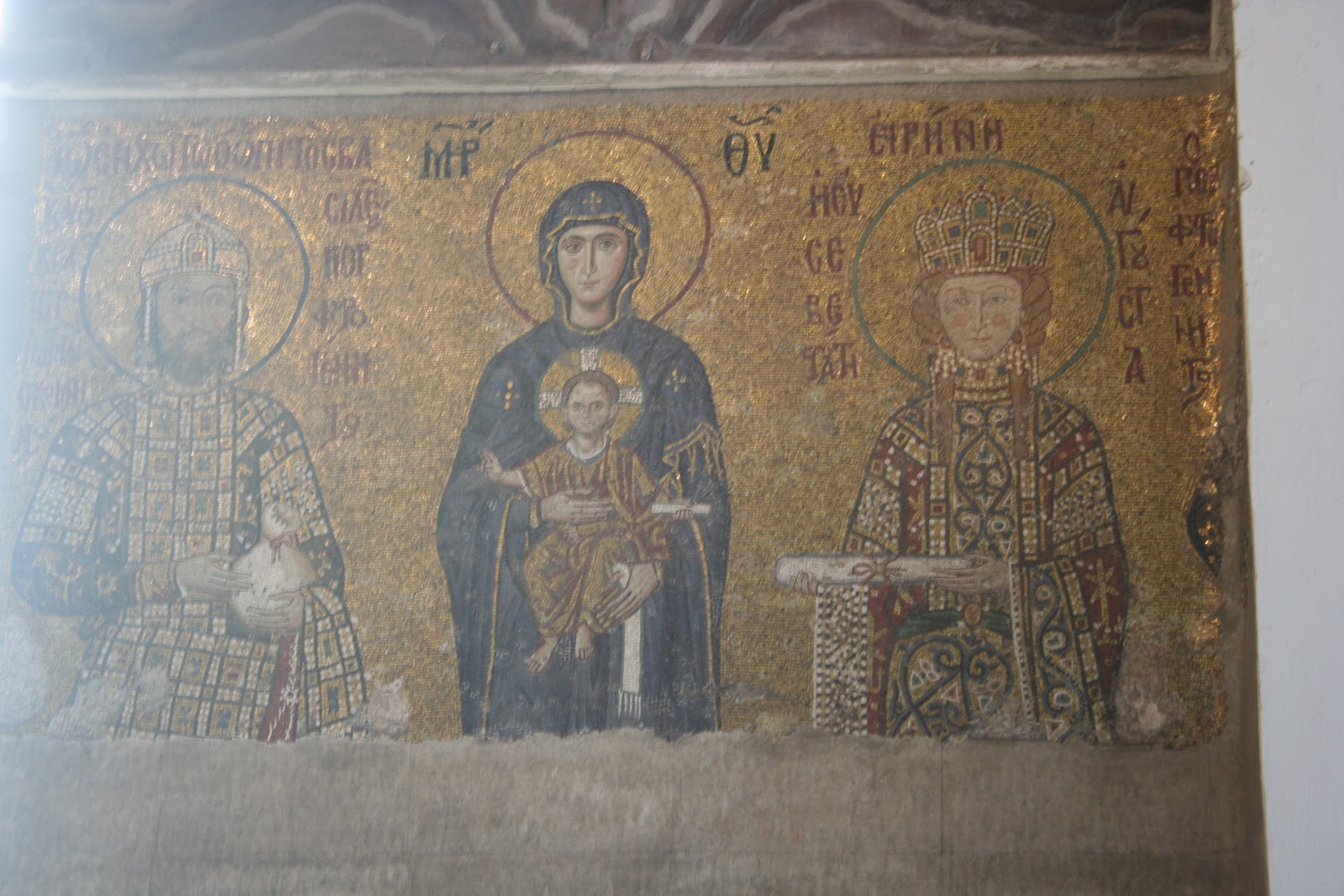
John II Komnenos, Virgin and Child, and Empress Eudoxia
Constantine IX Monomachos, Christ, and Empress Zoe.  Probably a bit hard to see in this picture, but Constantine's head has been altered; Empress Zoe was married three times, and Constantine was her final husband.  The mosaic probably previously displayed her two former husbands (they were emperors by virtue of being married to her).
Sorry for the poor quality of some of these pictures; the lighting was rather tricky.  Hopefully you at least get an impression of the skill and time necessary to create something like this.  At this point I'm not sure what else to show; I took about 150 pictures of Hagia Sophia, but to show them all would get repetitive.  I am in the process of setting up a Photobucket account, where you'll be able to see ALL the shots I took in a given day.  Details soon, hopefully.  Before leaving this magnificent place though, here's a shot of me inside:


After this, Kyle and I went to the Archaeological Museum.  I didn't take too many pictures, but here are a few choice pieces:

The so-called Alexander Sarcophagus, found in Sidon in the 19th century and made in the last quarter of the 4th century BC
7th century icon, the oldest surviving pre-Iconoclasm icon from Constantinople
Saint Eudoxia
We were planning on doing more today, but we were both pretty tired (I think yesterday's walking caught up with us) so we called it a day a bit early.  Tomorrow we should be checking out the Theodosian walls (in my opinion, the most impressive fortification ever constructed), the Studion (the monastery responsible for ended iconoclasm),  Chora Church (full of 13th-15th century mosaics), the Orthodox Patriarchate, and the Pantokrator monastery.  It sounds like a lot, but it's all in the same area more or less.  We'll see how it goes. Until next time!

Thursday, 21 June 2012

First Impressions: A City Between East and West

Day one of the trip is done, and to say that it was quite an experience would be an understatement.  Because of the hellish trip from Baltimore to Istanbul (48 hours of riding in cars, flying on planes, and waiting in airport terminals), I decided to try to keep today fairly light on the history and focus more on exploring Istanbul to get a feel for the city.  I'm also trying to pick up little bits of the language, but I don't expect I'll move beyond a basic understanding of pronunciation.  At least they use the Latin alphabet--I'm scowling at you, Russia--so some things look pretty familiar, even if they sound alien.  Actually, I think the Turkish language provides a pretty good analogy for the city itself: Western on the outside, but Eastern at its core.

Save for the minarets dotting the skyline, Istanbul looks much like one would expect a Western European city to look, at least a Western city with a medieval past.  Narrow, winding streets; cobblestones basically everywhere; the ubiquity of English on the streets, especially the ones near the major tourist sites.  But there is a decidedly Eastern flavor to the city, and it goes beyond the ratio of mosques to churches and burqas to bikinis.  It's a hard thing to put your finger on or to quantify, but I think it has to do with the ways in which you interact with the locals.

I've never been anywhere else where the locals are simultaneously extremely friendly and disturbingly pushy. Kyle--my OSU travelling buddy while in Istanbul--and I were approached by locals several times today, being offered help in finding something without our even having to ask.  But, afterwards, these apparent good Samaritans would try to shuffle us along into their shop, where we were always promised an excellent price on whatever they happened to be selling.  It was all harmless enough; to be sure they didn't like to be told no, but we never felt unsafe or overly pressured to peruse their wares.  And they were genuinely helpful; by no means am I trying to suggest that this friendliness was just a ploy to get customers.  But, I'm not exaggerating when I say that the entire city feels like a bazaar.  This can be a positive and negative, but it is unquestionably a new experience for me.  To call this sort of behavior "Eastern" might be unfair on my part; I've never been to the Eastern Mediterranean before, and so I'm relying on hearsay and stereotypes for my conception of the Near East.  But Istanbul certainly fits in with my ideas about the East, so I've gone ahead and made the comparison.  Feel free to disagree; I'd love to hear your thoughts in the comments!

Now, to get to what I actually did today.  Like I mentioned, I planned on keeping the day pretty light.  That didn't exactly play out, although I didn't go to any of the really major sites like Hagia Sofia, the Blue Mosque, Topkapi Palace, etc.  To start with, here's a picture of the hostel:


It's a great place; free breakfast, free wifi, showers and bathroom ensuite, and it couldn't be much closer to the center of the old city.

Kyle and I started the day with a stroll along the Bosporus and the sea walls, which originally went all the way down to the water but are now ringed by a major road.

A section of the sea walls.  On the left a walled-in gate, and farther down the wall a tower
The Bosporus.  The land on the left is Europe, and on the right is Asia
Quite a nice walk, except for the traffic.  The weather is absolutely gorgeous.  Not a cloud in the sky, low 80's with no humidity, and a lovely breeze off the water.

From here we decided to check out the actual bazaar.  But, to get there, we walked through the courtyards to Hagia Sophia and the Blue Mosque, as well as the Hippodrome.  One of the Hagia Sophia (I couldn't get a good one of the Blue Mosque)...

Hagia Sophia, built by Justinian in the early 6th century.  Lots more about this will come tomorrow, when I go inside.
..one of Kyle and myself...

Taken by one of the friendliest and least pushy Turks we met today
...and three of the different obelisks/columns in the Hippodrome (now a large public area, this was once where the chariot races were held, and also where Justinian had Belisarios slaughter 30,000 riotous Romans to maintain his hold on the throne.  See Procopius Wars 1.24 if you want more details).

Egyptian obelisk originally from the 15th century BC, brought to Constantinople in the 4th century AD, and put in the Hippodrome by Theodosius I in the 390's.
The base of the obelisk

The so-called walled obelisk, erected in the Hippodrome by Constantine VII Porphyrogenitos  in the 10th century AD.  It was originally covered in bronze, which was stripped by the crusaders in 1204.

The serpent column, originally built to commemorate the defeat of Xerxes in the 5th century BC and dedicated to Apollo at Delphi.  Constantine brought it to the Hippodrome in the 4th century AD.

After walking through this area we made it to the Grand Bazaar.  Built in 1461, it's one of the oldest closed-roof markets in the world, and it's a complete maze inside.  The wares range from chintzy to quite nice, with prices to match.


One of the numerous entrance gates

Inside
Next up was the Basilica Cistern.  Built by Justinian, this vast underground structure was made to store water for the city, in the event of a hardship such as a siege.  The columns were scavenged from older buildings, and have a mix of Doric (plain) and Corinthian (highly decorated) capitals.  This was really, really impressive (sorry for the blurriness; I wanted to abstain from using the flash, but without a tripod...):


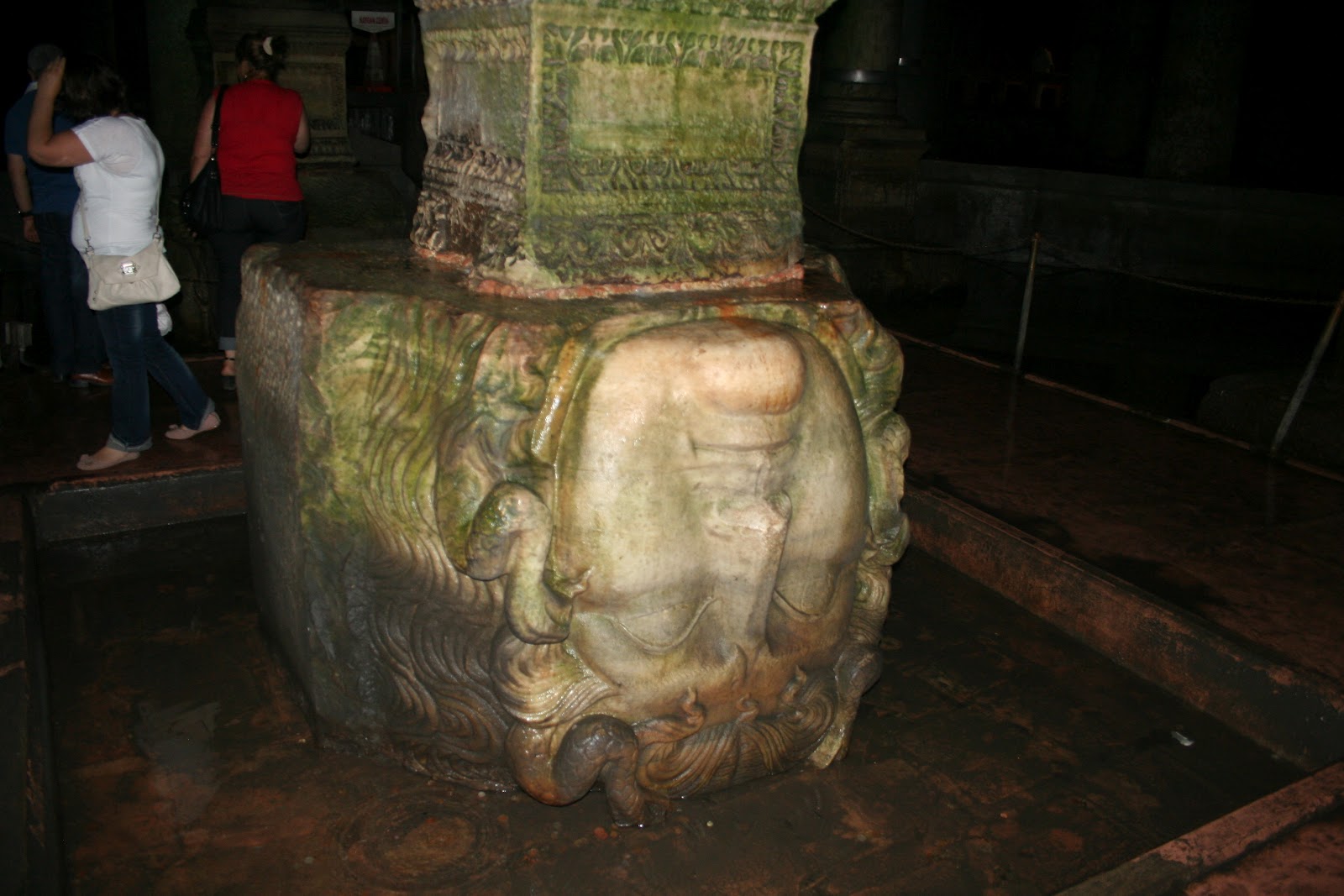
Way in the back of the cistern, there are 2 columns with medusa heads for bases:


These are especially interesting because of their placement: they're way in the back of the cistern, and one is upside down, the other sideways.  No one is exactly sure of the significance, but it seems to me that there must have been some sort of method to the madness (these are the only things in the whole place that aren't just your basic columns, they're put way out of the way, both are of medusa, and they're oriented differently), but I have no idea what significance that might be.

We were planing to call it a day after this, but we decided to see what else was close by first.  Much to our surprise, we found some really excellent stuff that we probably would have missed entirely otherwise.  The first was a church-turned-mosque, formerly called Sts. Sergius and Bacchus.  It's believed to be the church the Hagia Sophia was modeled off of, and dates to the early 6th century.  Although the interior is almost entirely redone, the architecture itself is original (notably, the columns and the Greek inscriptions that circles the interior.

Exterior


Original Roman capitals 
Close-up of the Greek inscription
After this, we one again decided to head back, but we decided to take a different route and walk along a different stretch of the water.  On the way, we stumbled across what's left of the Boukoleon, a Byzantine palace built in the 5th century by Theodosius II.  There's not too much left, but it's pretty impressive nonetheless.  It was originally built directly into the sea walls of Constantinople:


Hard to make out, but there is a tiny cross on the lintel of this door


We once again decided to head back to the hostel, but ran into yet another Byzantine imperial palace before we could get there.  This one is called the Palatium Magnum, and was built by Constantine when he founded Constantinople.  We happened upon a section of the palace while walking back...


But we circled around and discovered we could go inside!  We quite literally had the place to ourselves; this was beyond awesome (at least if you're into Byzantine history):


Some roof tiles 
Detail of the underside of a dome

After this, we actually made it back to the hostel and have been vegging out ever since.  I'm currently sitting in the common area smoking a hookah as I type this, and thinking about everything to see tomorrow.  Considering today was supposed to be a light day, tomorrow should really be busy!   I hope to do another post tomorrow evening, but the internet is painfully slow.  Even if they don't happen particularly quickly, I promise I will keep posting about everything I'm up to.  Please post comments/questions about what I've written here!